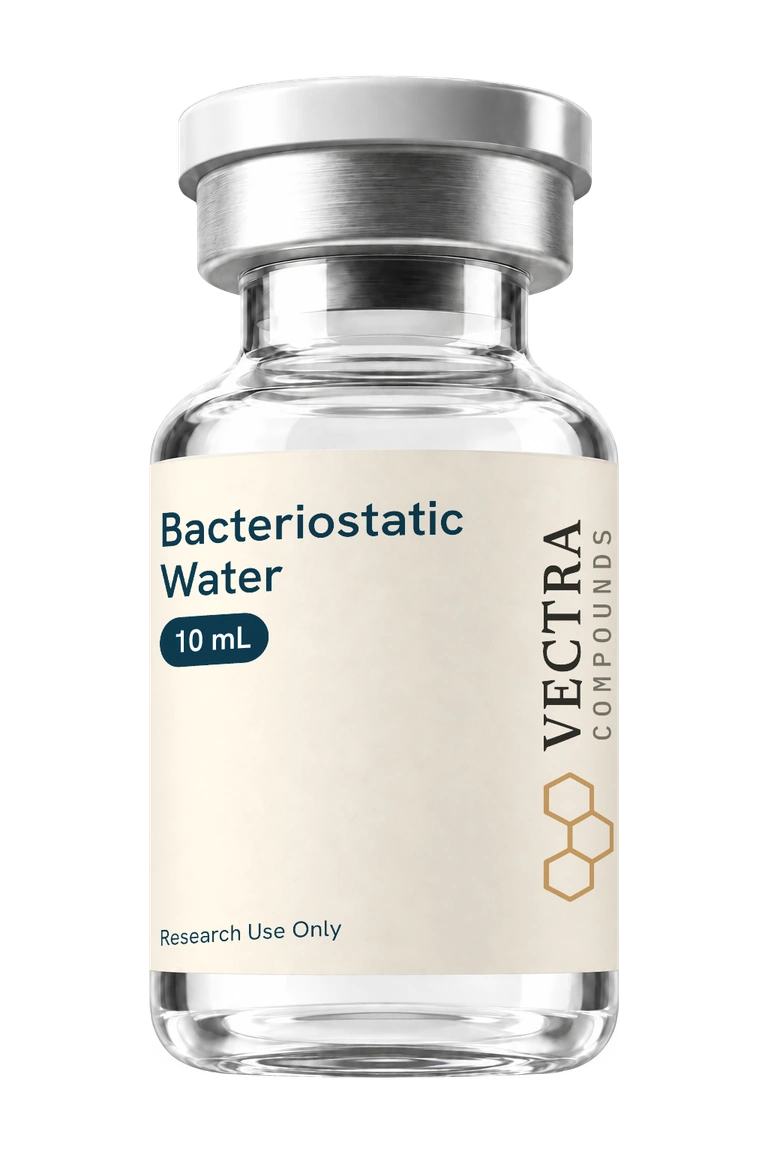
Analytical results for Bacteriostatic Water, 10 mL Diluent
Analysis
Result
Status
Identity
Benzyl Alcohol
Confirmed
Purity
99.97%
Reported
Net content
0.83%
Reported
Appearance
Clear Liquid
Reported
Only the assays this certificate reports are listed here. A reported value does not imply a passing specification.
Product details
About Bacteriostatic Water.
Bacteriostatic Water, a laboratory consumable supplied alongside the Vectra Research catalog. Not a research chemical; no therapeutic, preventive, or diagnostic claims are made or implied.
Refer to the product label and lot-specific documentation for storage and handling instructions.
What is included?
Bacteriostatic Water supplied in the selected 10 mL Diluent presentation. Other supplies are listed separately unless explicitly included in an offer.
How do I find the right COA?
Open the published report for this presentation. Check its product code and any printed lot against your diluent.
How do I know a vial contains what the label says?
These are the specific, documented failure modes that lot-level third-party analysis addresses. A report reachable from the lot code printed on the vial — without asking the seller for it — is the only document that answers 'is this vial what the label says'. That is why every Vectra vial carries a QR code resolving to its own lot's published report.
What does third-party testing actually find in this market?
Findings reported by commercial testing providers. Each names its source; none is registry- or peer-review-grade, so read them as a documented pattern rather than established prevalence.
Commercial testing surveys of peptides bought online report incorrect amino-acid sequences in roughly 30% of samples, and endotoxin above safety thresholds in roughly 65%. Heavy-metal contamination has been documented at up to ten times acceptable limits. These are vendor-testing figures, not registry or peer-reviewed data, and the sample selection is not independently audited.
Finnrick Analytics tested 508 samples across 73 vendors. Purity came back high — 96.69% to 99.95%. Quantity in the vial diverged from the label by up to ±75%. Those are separate failure modes: material can be genuinely pure and still be a fraction of the stated mass. A purity figure alone will not surface it.
Finnrick Analytics reported that roughly 34% of the 2025 certificates of analysis it reviewed had been altered. BTLabs reported roughly 20% of samples mislabeled since October 2025. Both are single-provider findings — read them as a documented pattern, not an established prevalence rate.
Vendor testing reports have documented outright substitution: vials that held only salt water or insulin rather than the peptide ordered, and GHRP-2 supplied as TB-500.
Can a certificate of analysis be faked?
Yes, and altered certificates have been reported in this market at material rates — see the testing findings above. Three properties make a report hard to fake:
It resolves from the lot code printed on the vial, so the document cannot be swapped independently of the physical unit.
Read the original research
There’s more behind the molecule.
Explore the published literature on Bacteriostatic Water. Start with the original papers, study methods and reported limitations.
Publications describe research on the molecule. They do not verify the identity, purity or performance of a Vectra product lot. Consult available product documentation for reported testing results.
Product documentation
Check the report. Review its details.
Check the published report's product code and any printed lot against your product.
It is hosted by the analysing laboratory, not by the seller, so the seller cannot edit it.
It names the laboratory and the method, so a third party can check whether that laboratory ran that assay.
Why is peptide identity data on the open web unreliable?
Peptide identity data in the vendor market is often wrong in ways that are hard to see. Near-identical compounds get their CAS numbers, residue ranges, formulas and molecular weights swapped. A certificate can be internally consistent and still describe a different molecule than the label names. Most commercial peptide material ships as an acetate salt, not free base. The two forms have different measured masses, so a figure quoted against the wrong one will not reconcile. A report that does not state which form it assayed cannot be checked at all.
What documentation should I require from any supplier?
The standard our own reports are built to meet:
A certificate tied to the exact lot code on the vial. Not to a product name, a batch family, or the supplier's own internal assay.
The analysing laboratory named, and reachable independently of the seller.
HPLC purity, stated against a declared salt form.
Mass spectrometry confirming the expected molecular weight.
Endotoxin testing below 1.0 EU/mg.
Sterility confirmation.
Quantity as well as purity. The Finnrick Analytics dataset reported label divergence in vial quantity of up to ±75% alongside high measured purity, so a purity figure alone will never surface a short-filled vial.
Has there been regulatory enforcement in this market?
FDA has acted in this market between 2024 and 2026. Actions include a civil forfeiture over $1.7 million against a compounding operation, several rounds of warning letters to peptide vendors, and more than thirty letters in March 2026 concerning compounded GLP-1 products.
Synthetic video using the likenesses of well-known public figures without their involvement has been used to promote peptide products. An endorsement is not evidence, and a recognisable face is not a document.
What should I compare when evaluating a supplier?
Buyers here increasingly compare document trail, not price.
Does a report exist for this exact lot?
Does it name the analysing laboratory?
Does it state salt form and method?
Can it be reached without asking the seller for it?