
99.84%
Total purityReport 2608131071 · Supplier batch B07E4-C · Freedom Diagnostics Testing · Completed Aug 20, 2026
- Report
- 2608131071
- Report date
- Aug 20, 2026
- Labelled
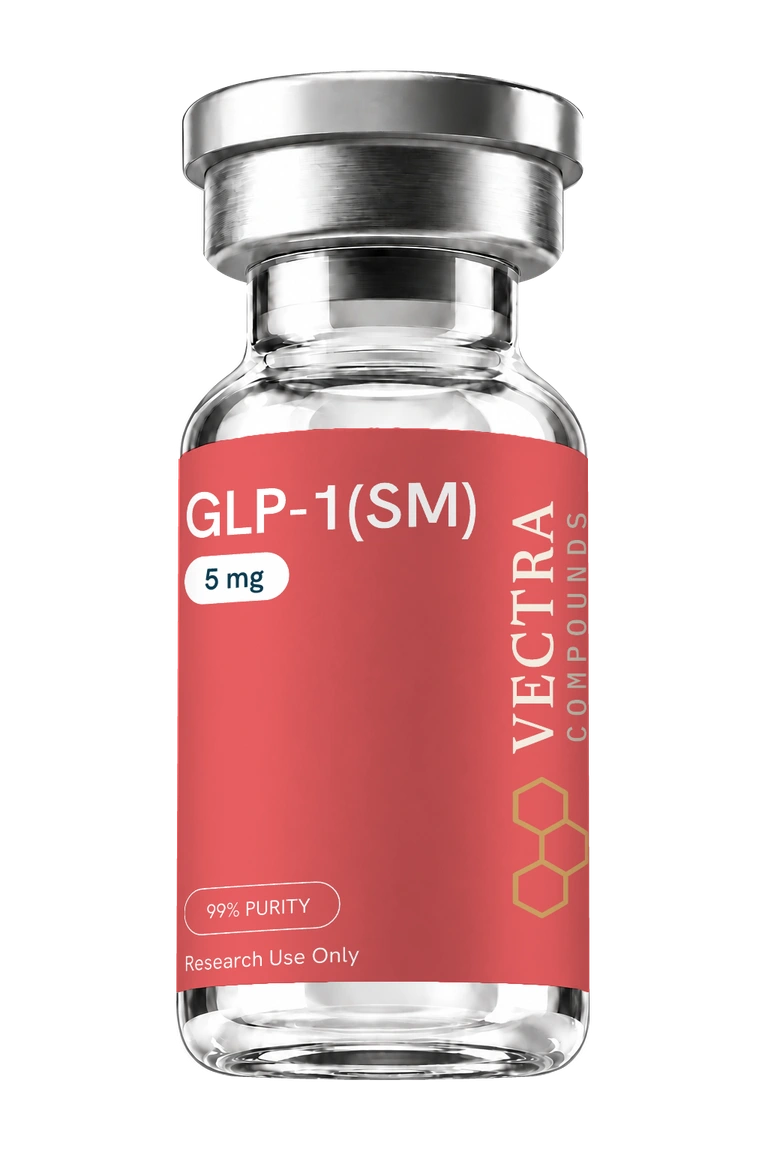
- 5 mg Vial
- Measured
- 6.39 mg

Quantity pricing
Buying several compounds?
These are the reported results for this exact presentation. A published report does not establish which physical lot is currently in stock.
Browse the COA library Print specification sheet99.84%
Total purityReport 2608131071 · Supplier batch B07E4-C · Freedom Diagnostics Testing · Completed Aug 20, 2026
| Analysis | Result | Status |
|---|---|---|
| Identity | GLP SM | Confirmed |
| Purity | 99.84% | Reported |
| Net content | 6.39 mg | Reported |
| Appearance | White Lyophilized Powder | Reported |
Only the assays this certificate reports are listed here. A reported value does not imply a passing specification.
Check the printed lot on your vial against the certificate card that matches it.
GLP-1(SM) peptide reference material for in-vitro laboratory research and analytical method development. Research use only. Not for human or veterinary use; no therapeutic, preventive, or diagnostic claims are made or implied.
Explore published literature Search PubMed for GLP-1(SM)Refer to the product label and lot-specific documentation for storage and handling instructions.
GLP-1(SM) supplied in the selected 5 mg Vial presentation. Other supplies are listed separately unless explicitly included in an offer.
Open the published report for this presentation. Check its product code and any printed lot against your vial.
GLP-1(SM) is a glp-1 receptor agonist. Engineered from native human GLP-1, with which it shares 94% structural homology.
Engineered for an extended half-life of roughly seven days, via albumin binding and resistance to DPP-4 degradation.
Reported to agonise GLP-1 receptors, enhancing insulin secretion, suppressing glucagon release, and delaying gastric emptying. We make no claim as to mechanism or effect.
FDA-approved products containing this active moiety exist, prescribed under their own labelling. This is a research-use reference material. It is not an approved product, it is not equivalent to one, and no approved product's data describes it.
An extensively studied GLP-1 receptor agonist. Trial programme details, participant counts and efficacy figures belong to the approved products' sponsors and are not reproduced here.
Studied in type 2 diabetes, obesity, cardiovascular risk reduction, and chronic kidney disease. We supply it as a reference material for in-vitro laboratory research and analytical method development only.
Explore the published literature on GLP-1(SM). Start with the original papers, study methods and reported limitations.
Publications describe research on the molecule. They do not verify the identity, purity or performance of a Vectra product lot. Consult available product documentation for reported testing results.
Check the published report's product code and any printed lot against your product.
These products are intended for laboratory research. Not for human or veterinary use.


Efficacy and safety data for the approved products belongs to their sponsors and is not reproduced here. Nothing about those products characterises this material.
Our sources carry no CAS number, formula, molecular weight, or sequence for this compound.
Approved products containing this moiety exist. This material is supplied for in-vitro research use only. No therapeutic, preventive, or diagnostic claims are made or implied.
These are the specific, documented failure modes that lot-level third-party analysis addresses. A report reachable from the lot code printed on the vial — without asking the seller for it — is the only document that answers 'is this vial what the label says'. That is why every Vectra vial carries a QR code resolving to its own lot's published report.
Findings reported by commercial testing providers. Each names its source; none is registry- or peer-review-grade, so read them as a documented pattern rather than established prevalence.
Yes, and altered certificates have been reported in this market at material rates — see the testing findings above. Three properties make a report hard to fake:
Peptide identity data in the vendor market is often wrong in ways that are hard to see. Near-identical compounds get their CAS numbers, residue ranges, formulas and molecular weights swapped. A certificate can be internally consistent and still describe a different molecule than the label names. Most commercial peptide material ships as an acetate salt, not free base. The two forms have different measured masses, so a figure quoted against the wrong one will not reconcile. A report that does not state which form it assayed cannot be checked at all.
The standard our own reports are built to meet:
FDA has acted in this market between 2024 and 2026. Actions include a civil forfeiture over $1.7 million against a compounding operation, several rounds of warning letters to peptide vendors, and more than thirty letters in March 2026 concerning compounded GLP-1 products.
Buyers here increasingly compare document trail, not price.